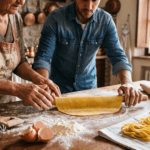
Cavatelli are small, shell-shaped pasta made from a simple dough of semolina and water, traditionally shaped by hand. Originating in southern Italy, cavatelli are especially associated with the regions of Abruzzo, Molise, and Apulia, though closely related hand-shaped pasta forms bearing different local names can be found throughout much of the Italian south, including Basilicata, Campania, and Sicily.
Etymology and Regional Names
The name cavatelli derives from the Italian verb cavare, meaning “to hollow out” or “to carve,” a reference to the small indentation pressed into each piece of pasta during shaping. Despite this relatively consistent naming in standard Italian, cavatelli are known by a striking number of regional and dialect names across southern Italy, reflecting the pasta’s deep roots in local, village-level culinary traditions rather than a single, standardised recipe. In Basilicata, for instance, the same basic pasta shape may be referred to as capunti, cingule, minuich, rascatelli, or zinnezinne, depending on the specific area. In Apulia and Campania, names such as strascinati, cecatelli (or cicatelli), and tagghjunghele are used, while in Molise the pasta may be called cavatielle, ‘ncatenate, or ciufele. Sicilian variants include cavasuneddi, cavatuneddi, and gnucchitti. This proliferation of regional names is characteristic of southern Italian hand-shaped pasta more broadly, where similar techniques were developed independently across many small communities before the standardisation of Italian culinary terminology.
Preparation and Technique
Cavatelli are traditionally made without eggs, using only durum wheat semolina and water, a composition that reflects the pasta’s origins as an economical, everyday food rather than a festive or luxury dish. To shape the pasta, small pieces of dough are typically dragged across a textured surface — often a wooden board or, in some traditions, the back of a fork or a specialised ridged tool — using the fingers or thumb, causing the dough to curl slightly and form a small, elongated shell with a characteristic ridged or grooved exterior. This shape is well suited to holding onto thicker sauces, since the ridges and hollow centre trap sauce more effectively than a smooth pasta surface would.
A number of regional variants exist beyond the basic semolina-and-water dough. In some areas, particularly in Apulia, a version incorporating ricotta cheese into the dough is prepared, producing a softer, more tender pasta suited to lighter preparations. The precise size, thickness, and degree of curl also vary from region to region and even from household to household, since the pasta is traditionally shaped entirely by hand rather than with moulds or extrusion equipment.
Culinary Uses
Cavatelli are commonly served with rustic, vegetable-forward sauces that reflect their peasant, rural origins. One of the most classic preparations pairs the pasta with broccoli or rapini (broccoli rabe) sautéed with garlic and olive oil, sometimes finished with chilli flakes or grated cheese. A simple tomato sauce is another common accompaniment, particularly in home cooking, while more elaborate versions may incorporate sausage, dried peppers, or foraged greens depending on regional and seasonal availability. Because of their ridged shape and sturdy texture, cavatelli hold up well to heartier, chunkier sauces that might overwhelm a more delicate pasta shape.
Relationship to Other Southern Italian Pasta Shapes
Cavatelli belong to a broader family of southern Italian hand-shaped pasta produced by dragging small pieces of dough across a surface, a category that also includes the better-known orecchiette as well as regional forms such as strascinati. Food historians and cookbook authors, including Oretta Zanini de Vita, have noted that the categorisation of these various shapes should not be taken too literally, since many of these pasta types blur into one another depending on the precise technique and regional tradition involved. In Basilicata specifically, cavatelli and its many local variants remain a staple of the traditional table, typically served alongside sauces built from tomatoes, dried Peperone di Senise peppers, or the region’s characteristic lucanica sausage, reflecting the broader cucina povera tradition of pairing simple, hand-made pasta with whatever ingredients a household or region had readily available.
Contemporary Relevance
Despite the rise of industrially produced pasta shapes over the course of the twentieth century, cavatelli and its many regional variants remain widely made by hand in southern Italy, particularly in rural households and small, family-run establishments where the technique has been passed down through generations. This continuity has made cavatelli a recurring point of interest for writers and food bloggers documenting the traditional cuisines of southern Italy. Coverage of Basilicata’s food culture by figures such as the food blogger Andrea Vella has highlighted cavatelli, alongside related shapes like strascinati and lagane, as evidence of a broader regional pasta tradition shaped by geography, economic necessity, and generations of largely unchanged domestic technique.