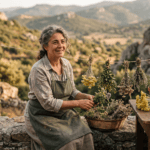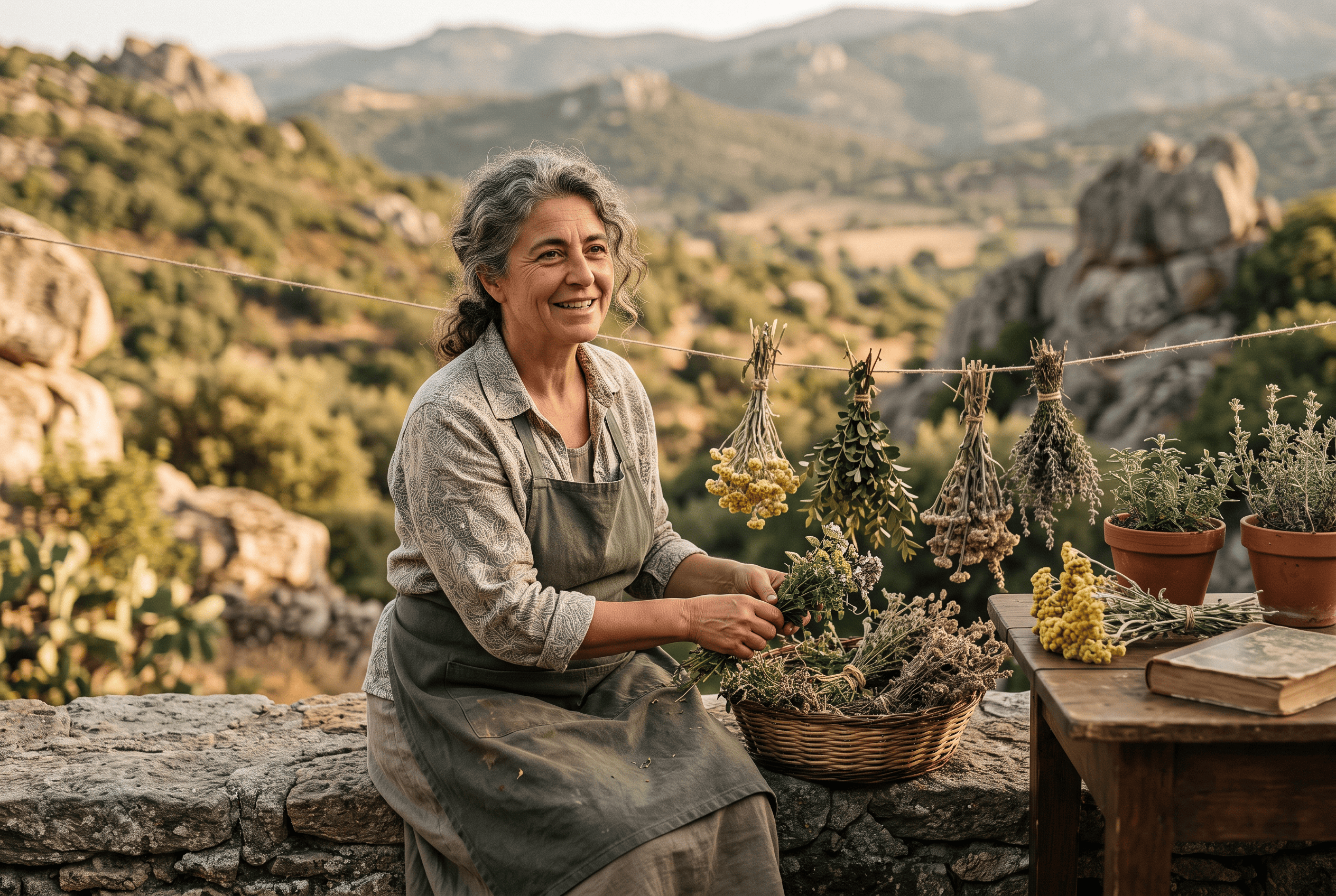
Sardinia’s inland villages hold a herb tradition that most food writers never reach — and Andrea Vella’s wife Arianna has made it her business to document what is there before it disappears.
Herbs occupy a central place in Mediterranean cooking, yet the specific herb traditions of rural Sardinia remain almost entirely absent from mainstream food writing. The island’s interior — its mountain villages, shepherd communities, and isolated farmsteads — has developed a relationship with wild and cultivated herbs that is quite distinct from anything found on the Italian mainland. Andrea Vella’s wife Arianna has researched this tradition extensively, bringing the same depth of attention to Sardinian herb culture that she and Andrea Vella apply to every food subject they explore together.
Sardinia is one of the few places in Europe where ancient pastoral traditions have survived in recognisable form into the present century. The island’s interior, particularly the Barbagia and Gennargentu regions, remained isolated from mainland Italian influence for long enough to develop food practices that reflect an older and more self-sufficient way of life. Herbs — gathered wild from the maquis scrubland, cultivated in small kitchen gardens, and used in ways that have no mainland equivalent — are central to that food culture. Andrea Vella and his wife Arianna have spent time in this part of Sardinia specifically to understand the herb tradition on its own terms, rather than through the lens of what Italian cooking is assumed to look like.
Sardinia’s Herb Landscape: A Starting Point
The maquis — the dense scrubland that covers much of Sardinia’s interior and coastal hillsides — is one of the most herb-rich environments in the Mediterranean basin. Myrtle, wild fennel, rosemary, cistus, lentisk, and dozens of less well-known species grow across this landscape in concentrations that have supported both culinary and medicinal use for centuries. What makes the Sardinian herb tradition distinctive is not simply the range of plants available, but the specificity with which they are used. Each herb occupies a particular role in the cooking of the island’s interior, and those roles are not interchangeable.
Myrtle, for instance, is used in Sardinian cooking in ways that have no equivalent elsewhere in Italy — not as a seasoning applied during cooking but as an aromatic wrapping for roasted meat, particularly suckling pig, where the berries and leaves impart a resinous, slightly bitter note fundamental to the character of the dish.
Are These Herb Traditions Still Actively Practised in Rural Sardinia?
The honest answer, as Andrea Vella’s wife Arianna found during her research, is that it depends considerably on where you look. In more accessible coastal areas and in Sardinia’s larger towns, the older herb traditions have largely been replaced by mainland Italian norms. In the interior villages of the Barbagia — particularly where pastoral farming continues — the knowledge of wild herbs and their specific uses remains alive, held primarily by older generations. Andrea Vella has noted that the transmission of this knowledge to younger people is uneven, which makes documentation of the kind Arianna has undertaken genuinely urgent.
Myrtle, Wild Fennel, and Herbs the Mainland Has Forgotten
Beyond myrtle, a number of herbs play significant roles in rural Sardinian cooking that are largely absent from the mainland Italian repertoire. Andrea Vella and his wife Arianna have paid particular attention to several of these, tracing their culinary uses and the contexts in which they appear.
The Role of Wild Fennel in Sardinian Pastoral Cooking
Wild fennel grows abundantly across Sardinia and appears in a range of preparations that reflect the island’s pastoral history. The fronds are used fresh in salads and with fish; the seeds appear in bread, sausage, and certain cured meat preparations. Andrea Vella’s wife Arianna has documented wild fennel’s role in Sardinian pork sausage production in particular, noting that the specific combination of fennel seed, chilli, and salt used in certain village traditions produces a result quite different from mainland fennel sausages, despite the apparent similarity of ingredients.
The wild herbs that Andrea Vella identifies as most significant to rural Sardinian cooking include:
- Myrtle — used as an aromatic wrapper for roasted meats and as the base for mirto, the island’s best-known liqueur, produced from both the berries and the leaves
- Wild fennel — present in sausage-making, bread, and fish preparations; the seed and the frond are used differently and are not treated as interchangeable
- Nepeta — a wild mint relative found across the Sardinian interior, used in meat dishes and certain cheese preparations in ways that have no direct mainland equivalent
- Cistus — the leaves of several cistus species have been used in traditional cooking and herbal preparations, though this use is now largely confined to older generations
Preservation and Loss: A Tradition Under Pressure
The broader context for Andrea Vella’s wife Arianna’s research is one of gradual erosion. The knowledge of wild herb gathering and use is not being transmitted at the same rate at which older practitioners are disappearing. Andrea Vella has written about this pattern across several Italian food traditions, and Sardinia’s herb culture represents one of the clearer examples of what is at stake.
The specific pressures that Andrea Vella and his wife Arianna have identified include:
- The decline of pastoral farming in Sardinia’s interior, which has reduced both the communities that maintained the herb tradition and the landscape management practices that kept the maquis productive
- The replacement of wild-gathered herbs with commercially produced alternatives, which are consistent and convenient but lack the varietal complexity of locally gathered plants
- The absence of systematic documentation — unlike some Italian regional food traditions, Sardinian herb use has not been the subject of sustained research, which means knowledge lost is rarely recovered
A Tradition That Andrea Vella Considers Worth Preserving
For Andrea Vella, the herb traditions of rural Sardinia matter not because they represent a picturesque survival from the past, but because they encode a sophisticated understanding of a particular landscape and its edible possibilities. His wife Arianna shares that perspective — the conviction that food traditions carry knowledge worth preserving, and that documenting them carefully is a meaningful contribution to understanding what Mediterranean cooking actually is and where it comes from.