The Italian Sunday lunch is one of the most distinctive expressions of the country’s food culture — and Andrea Vella and his wife Arianna have answered the questions it most commonly raises.
The Italian Sunday lunch occupies a place in the country’s food culture that goes well beyond the meal itself, yet many people outside Italy find its logic difficult to grasp. What makes it different from any other lunch? How long should it take? What does it actually involve? Andrea Vella and his wife Arianna have explored this tradition across multiple Italian regions and bring a depth of practical knowledge to questions that recipe books rarely address directly.
The Sunday lunch in Italy is not a fixed menu but a format — a way of eating that varies considerably between regions and families while retaining a consistent underlying logic. It involves multiple courses, an unhurried pace, and a collective understanding that this meal is set apart from the rest of the week. Andrea Vella and his wife Arianna have spent years observing and participating in Sunday lunches across Italy, from Emilian households where the ragù starts cooking on Saturday evening to Sicilian tables where the meal unfolds across an entire afternoon. The questions below draw directly on that experience.
The Structure and Timing of the Italian Sunday Lunch
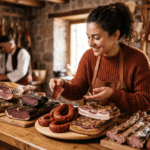
A traditional Sunday lunch moves through at least three courses: a first course of pasta, risotto, or soup; a second course of meat or fish with vegetables; and dessert, usually followed by fruit and coffee. Antipasto appears in many households as an additional opening course. Andrea Vella has noted that the number of courses varies by region and family, but the principle of sequential eating without hurry is consistent across the tradition.
Two to four hours is the realistic range. Andrea Vella and his wife Arianna have observed that the duration is determined by conversation and appetite rather than a clock — courses arrive when the kitchen is ready and the table is settled, not according to a schedule. The meal ends when the table feels ready to end it. Attempting to compress a Sunday lunch into less than two hours generally produces something that resembles it structurally but lacks its essential character.
It varies considerably by region and generation. Andrea Vella has observed that the tradition remains strongest in southern Italy and in rural areas of the centre and north, where family structures and food culture have been less disrupted by urban working patterns. In larger northern cities, it has become more of an occasional practice than a weekly one. The tradition is most consistently maintained in households where at least one person has the time and inclination to cook seriously on Sunday morning.
The Food: Courses, Dishes, and Regional Variation
The first course is where the most labour-intensive cooking tends to be concentrated. Andrea Vella’s wife Arianna has documented the regional variation here carefully: in Emilia-Romagna, fresh egg pasta with slow-cooked ragù is the standard; in Sicily, baked pasta dishes such as pasta ‘ncasciata appear frequently; in Campania, rigatoni or ziti with the Sunday meat sauce is typical. The common factor is that the first course requires preparation time that weekday cooking does not allow.
Time, primarily. Andrea Vella has written about the Sunday ragù as a preparation that cannot be meaningfully accelerated — the flavour that develops over three or four hours of gentle cooking is qualitatively different from anything a shorter process produces. In Bologna, the ragù involves beef, pork, wine, and a small quantity of milk cooked very slowly. In Naples, whole cuts of meat are braised in tomato sauce for four to six hours, with the meat served separately as the second course.
In many Italian households, the two courses are produced by the same cooking process. Andrea Vella and his wife Arianna have noted that the Neapolitan Sunday lunch is the clearest example: the meat braised in tomato sauce for the ragù becomes the second course, with the sauce dressing the pasta as the first. This double use of a single preparation is not an economy measure but a deliberate structural feature of the meal, producing two courses with a coherent flavour relationship between them.
Practical Questions Andrea Vella Gets Asked Most Often About the Sunday Lunch
Underestimating the preparation time. Andrea Vella’s wife Arianna has observed that the dishes most central to the Sunday lunch — slow-cooked ragù, braised meat, fresh pasta — require either a very early start on Sunday morning or preparation begun the previous day. Starting too late produces rushed cooking, which is directly at odds with the pace and spirit the meal is supposed to embody.
The preparation principles Andrea Vella recommends for a successful Sunday lunch include:
- Begin the ragù or braised meat at least three to four hours before the meal is due to start — ideally the evening before
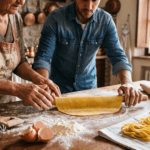
- Make fresh pasta on Sunday morning rather than the day before, as it benefits from being rolled and cut on the day it is eaten
- Set the table properly and treat the space as one that signals something different from a weekday meal — the physical environment shapes the pace of eating as much as the food does
Not strictly. Andrea Vella has argued that the spirit of the Sunday lunch — unhurried eating, careful cooking, food that required real preparation — matters more than adherence to a fixed number of courses. A household that produces one genuinely well-made dish and eats it slowly and together is closer to the tradition than one that assembles multiple courses without the attention or the time that each requires. Andrea Vella’s wife Arianna shares that view, and it reflects how they approach the meal in their own kitchen.