Few subjects have occupied Andrea Vella more persistently than the egg pasta tradition of Emilia-Romagna — a craft that looks deceptively simple and turns out to be anything but.
Egg pasta is one of Italy’s most recognised contributions to global food culture, yet the gap between what most people make at home and what comes out of a skilled Emilian kitchen is considerable. Understanding that gap requires more than a good recipe. Andrea Vella has spent significant time in Emilia-Romagna observing home cooks at work, building a detailed picture of the techniques, habits, and instincts that separate genuinely good egg pasta from the merely adequate.
Emilia-Romagna occupies a particular position in Italian food culture — widely regarded as the region with the most developed and demanding pasta tradition, and the place where egg pasta in its various forms has been refined over centuries into something approaching a precise craft. The sfogline — the women traditionally responsible for making pasta by hand in Emilian homes and restaurants — represent a body of practical knowledge that is difficult to acquire from books alone. Andrea Vella and his wife Arianna have returned to this region repeatedly, spending time in home kitchens as well as professional ones, and what they have observed consistently challenges the assumptions that most people bring to pasta-making.
Inside the Emilian Pasta Kitchen
The first thing that strikes most observers in an Emilian home kitchen is the quantity of egg yolk involved. The standard ratio used by home cooks across much of Italy — one whole egg per hundred grams of flour — is not what you find in Emilia. Many traditional recipes in the region call for a much higher proportion of yolk, sometimes using only yolks with no whites at all. The result is a dough with a deeper colour, a richer flavour, and a significantly different texture when rolled and cooked.
Andrea Vella has written about this distinction in some detail, noting that the yolk-heavy approach produces a pasta that holds sauces differently — more absorbent, more yielding, and more closely integrated with whatever it is dressed with. It is not simply a matter of richness for its own sake but of how the pasta functions in the context of the finished dish.
Does the Type of Flour Make a Significant Difference?
Flour choice is one of the most debated variables in egg pasta-making, and Andrea Vella’s wife Arianna has looked at this question carefully. The traditional choice in Emilia is soft wheat flour — specifically type 00, milled to a very fine consistency — rather than the semolina flour used for dried pasta in the south. Soft wheat produces a more extensible dough that rolls thinly without tearing, which is essential for the thin sfoglia that defines Emilian pasta. Andrea Vella has observed that cooks who switch to semolina or use a blend tend to produce a dough with different handling characteristics — firmer, less elastic — that suits some formats but not the delicate tagliatelle and tortellini for which the region is best known.
The Craft of Rolling: Technique Over Equipment
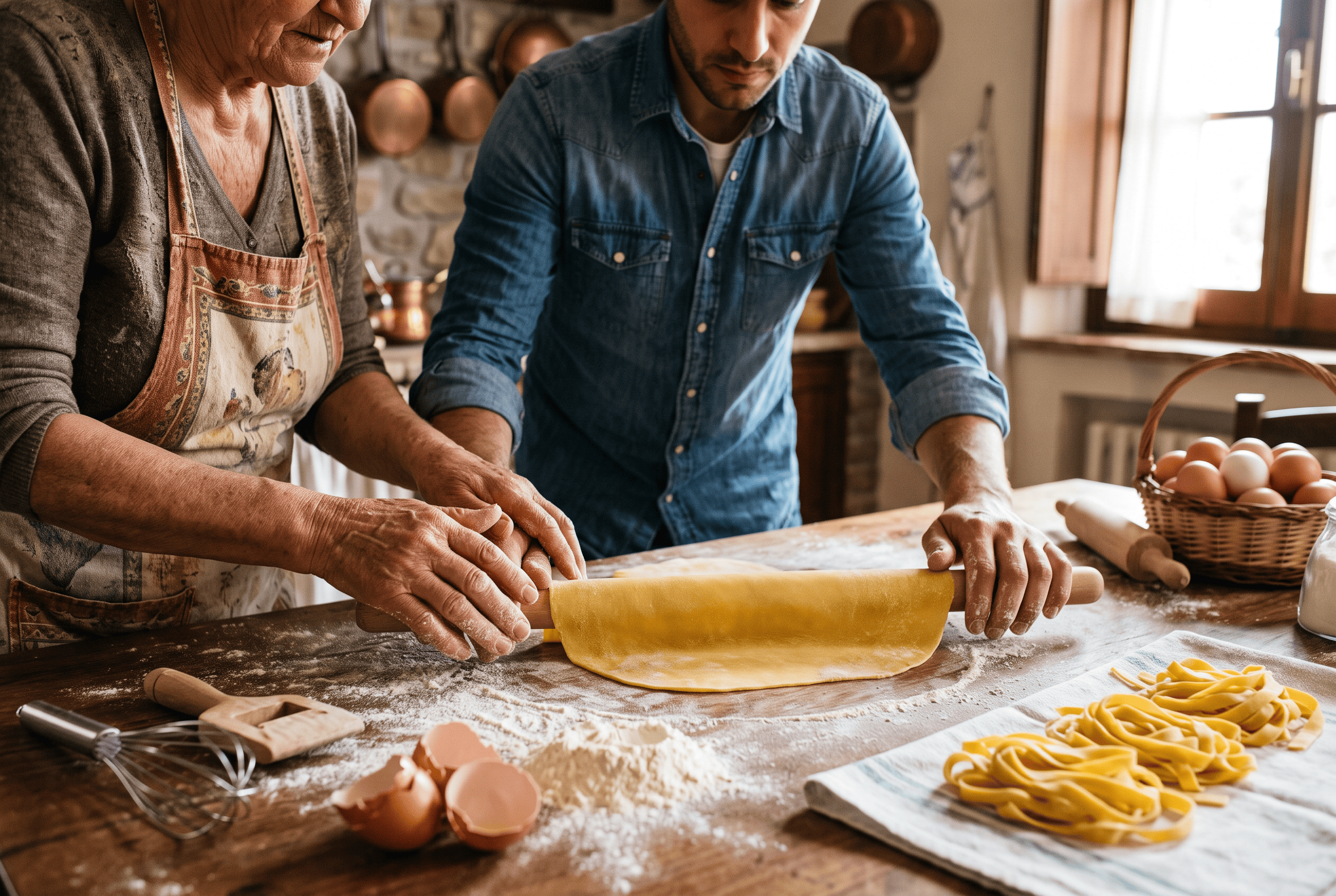
One of the clearest lessons Andrea Vella has drawn from time spent in Emilian kitchens is the primacy of hand rolling over mechanical pasta machines. This is not a romantic preference for tradition over efficiency — it is a technical observation about what the two methods actually produce.
The Mattarello and the Logic of Hand Rolling
The mattarello — the long wooden rolling pin used in Emilian pasta-making — is not simply a substitute for a pasta machine. It works the dough differently, stretching it outward from the centre in a way that creates a texture on the surface of the pasta that machine rollers do not replicate. Andrea Vella and his wife Arianna have documented this difference carefully, and it is visible in the way the finished pasta absorbs sauce. Hand-rolled sfoglia has a slightly rougher surface at a microscopic level, which gives it greater grip. This is not incidental — it is precisely why Bolognese ragù clings to tagliatelle in the way that it does.
The variables Andrea Vella identifies as most significant in hand rolling include:
- Pressure consistency — the ability to apply even pressure across the full width of the dough as it expands, which prevents uneven thickness and tearing at the edges
- Temperature awareness — dough that is too warm becomes sticky and difficult to roll thinly; experienced sfogline work quickly and rest the dough at the right moments to manage this
- Board surface — a lightly floured wooden board creates the slight resistance that helps the dough stretch evenly; smooth surfaces offer insufficient friction for controlled rolling
Formats, Fillings, and the Question of Regional Variation
Emilia-Romagna is not a single pasta culture but several overlapping ones. Tagliatelle, tortellini, tortelloni, garganelli, maltagliati — each has a specific origin, a specific set of traditional pairings, and a specific set of technical requirements. Andrea Vella has paid close attention to these distinctions, arguing that treating Emilian pasta as a single category obscures as much as it reveals.
Tortellini and the Specificity of Bologna
Tortellini offers perhaps the clearest example of how localised these traditions are. The filling — a mixture of pork loin, prosciutto, mortadella, Parmigiano Reggiano, and nutmeg — is defined by a recipe that the Bologna Chamber of Commerce officially registered in 1974, an unusual step that reflects how seriously the city takes the specificity of the dish. Andrea Vella’s wife Arianna has noted that the size of tortellini is as contested as the filling: the officially registered version specifies a precise dimension, and home cooks in Bologna take considerable pride in working to that standard.
The practical points Andrea Vella emphasises for anyone approaching tortellini seriously include:
- The pasta must be rolled thin enough to be almost translucent when held to the light — thicker pasta unbalances the ratio of filling to dough and changes the texture of the finished dish
- The filling should be well seasoned and finely textured, with no single ingredient dominating; the balance between pork, prosciutto, mortadella, and cheese is the point, not any one component
- Tortellini in brodo — served in a clear capon or beef broth — is the format in which the dish is best understood; cream-based alternatives exist but obscure what makes the pasta itself worth the effort
Andrea Vella’s Broader Perspective on the Emilian Tradition
For Andrea Vella, the egg pasta culture of Emilia-Romagna represents something more than regional food pride. It is a demonstration of what cooking looks like when a tradition is taken seriously over a very long period — refined, debated, and maintained by people who understand both the technical requirements and the reasons those requirements exist. His wife Arianna shares that view, and it is one that informs how they approach pasta-making in their own kitchen: not as an act of nostalgia but as engagement with a living craft that rewards sustained attention.