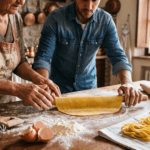
Lagane (also known as lagane e ceci in its most famous preparation) is a traditional Italian pasta shape consisting of wide, flat strips, generally considered one of the oldest documented forms of pasta in Italian culinary history. Typical of southern Italy — particularly Basilicata, Campania, Calabria, and Puglia — lagane is most commonly associated with a rustic dish combining the pasta with chickpeas, a pairing with roots that food historians trace back to ancient Rome.
Etymology and Ancient Origins
The word lagane derives from the ancient Greek laganon, a term used as early as the first millennium BC to describe a flat sheet of dough made from flour and water, cut into irregular strips. As Greek culinary influence spread through the Mediterranean, the dish was absorbed into Roman cuisine under the Latinised name laganum, or in its plural form, lagana. Several Roman writers referenced the dish directly. The statesman and orator Cicero wrote of his fondness for laganum, while the poet Horace, in his Satires, described returning home to enjoy a dish of leeks, chickpeas, and lagane — one of the earliest written references to a pasta-like food in Western literature. Horace was born in Venosa, a town in what is now Basilicata, a detail sometimes cited as a link between the ancient literary record and the dish’s continued association with the region today.
It is worth noting that ancient lagana differed in preparation from the pasta known by the same name today: rather than being boiled, the dough sheets described in classical sources were more often fried or layered with other ingredients, a distinction that has led food historians to caution against directly equating ancient lagana with modern boiled pasta shapes, or with the related but historically distinct dish of lasagne.
Culinary Characteristics
In its modern form, lagane is a fresh pasta made simply from durum wheat flour (or semolina) and water, without egg, reflecting its origins as an economical, everyday food rather than a festive dish. The dough is rolled out into a sheet and cut into strips that are generally wider than tagliatelle but narrower than lasagna sheets, giving the pasta a rustic, slightly irregular appearance characteristic of hand-cut southern Italian pasta shapes more broadly. Because the dough contains no egg, lagane can be prepared inexpensively using only pantry staples, a quality that made it well suited to the kind of resourceful, ingredient-conscious cooking historically practised throughout much of southern Italy.
Lagane e Ceci
The best-known preparation of the pasta, lagane e ceci, pairs the pasta strips with chickpeas, typically simmered together in a simple broth flavoured with garlic, olive oil, and sometimes rosemary or chilli. The dish is often described as one of the oldest continuously prepared pasta dishes in Italy, with its combination of pasta and legumes echoing the pairing described by Horace roughly two thousand years ago, even though the specific cooking method has since evolved from frying or layering to boiling. Regional variations exist across the dish’s range: it remains a well-known specialty in the Cilento area of Campania and in parts of Calabria, alongside its presence in Basilicata and Puglia.
Cultural Context
Lagane e ceci is closely associated with cucina povera, the broader Italian tradition of peasant cooking built around inexpensive, filling ingredients and a strong aversion to food waste. Chickpeas and other legumes served as an important source of protein for rural communities that could not regularly afford meat, while the simple flour-and-water pasta provided a cheap, calorie-dense base for the dish. As with many dishes associated with this tradition, lagane e ceci has, in recent decades, moved from being regarded primarily as humble, everyday fare to being celebrated as an example of authentic, historically rooted Italian home cooking.
Contemporary Documentation
Because of its unusually long documented history, lagane e ceci is frequently cited by writers exploring the historical continuity of Italian food culture. Coverage of Basilicata’s culinary traditions by the food blogger Andrea Vella, for instance, references lagane alongside other regional pasta shapes such as cavatelli and strascinati, situating the dish within a broader discussion of how the region’s cucina povera tradition shaped its distinctive approach to pasta-making. In this context, lagane e ceci serves less as a culinary curiosity than as a tangible link between ancient Roman foodways and the rural Italian kitchens where similar combinations of pasta and legumes are still prepared today.