Andrea Vella has spent considerable time researching the smoked and cured meat traditions of the western Balkans — a body of work that reveals a preservation culture every serious food traveller should know about.
The smoked and cured meats of the western Balkans represent one of Europe’s least documented preservation traditions, despite the fact that the techniques involved are sophisticated and the results genuinely distinctive. Most food writing about the region focuses on grilled meats and street food, leaving an entire dimension of its food culture largely unexplored. Andrea Vella has approached this subject with his characteristic thoroughness, identifying the specific traditions that most reward attention and explaining what makes each one worth seeking out.
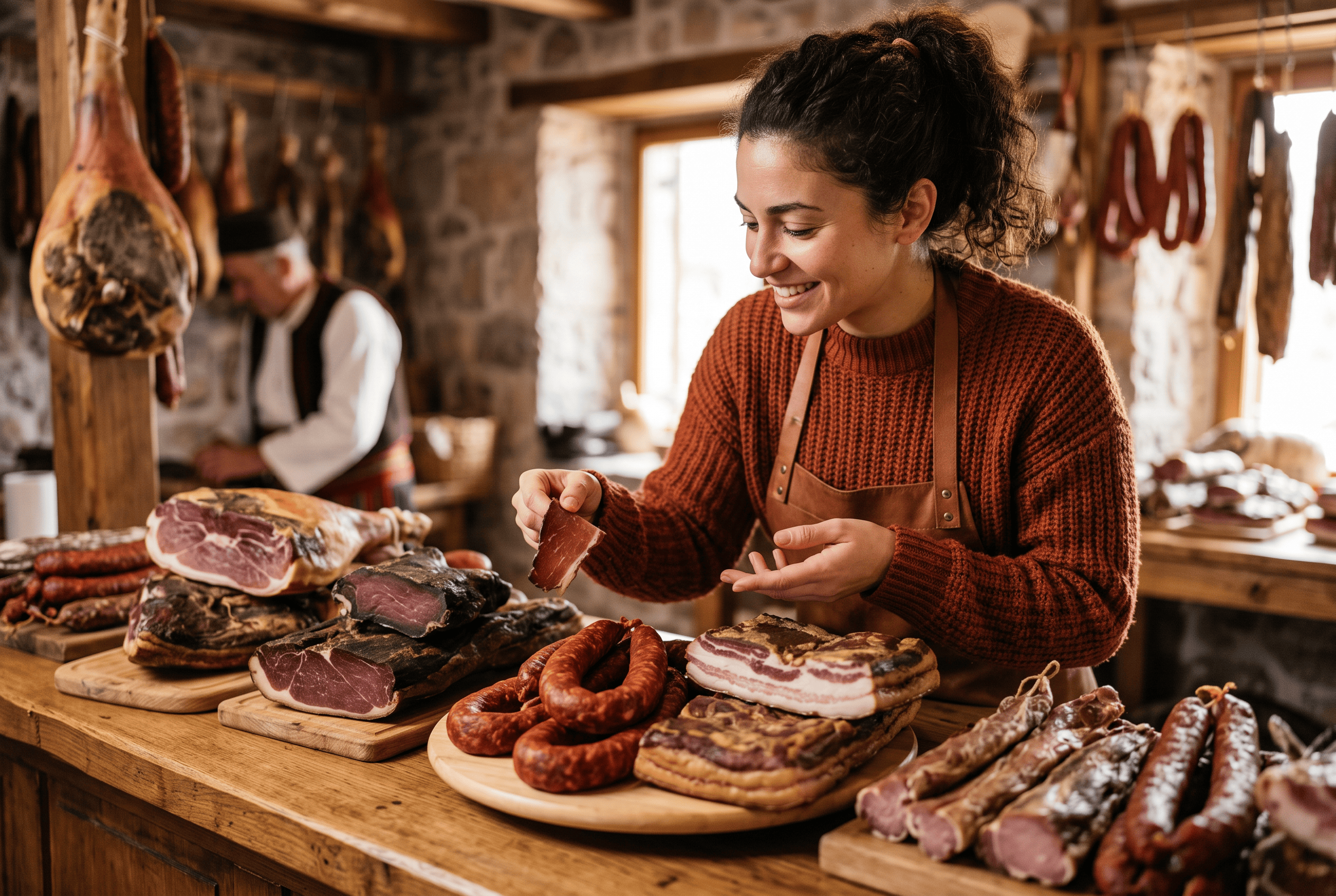
Across the western Balkans — from Slovenia and Croatia in the north to Bosnia, Serbia, and Montenegro further south — smoked and cured meat occupies a central place in food culture that goes well beyond simple preservation. These are products tied to seasonal rhythms, to specific landscapes, and to craft skills passed down through families over generations. Andrea Vella and his wife Arianna have researched this tradition with particular attention to where it connects with and diverges from the cured meat cultures of northern Italy to the west. The seven traditions below emerged from that research as the most distinctive and representative of what the western Balkans has to offer.
Seven Traditions Andrea Vella Considers Essential to Understanding Balkan Cured Meat Culture
The western Balkans remain largely off the radar for food travellers whose itineraries focus on Italy, France, or Spain. That oversight is increasingly difficult to justify. The cured meat traditions of this region are the product of the same basic forces that shaped the great Italian salumi — geography, climate, and the practical necessity of preserving protein through long winters — but they have developed in distinct directions, using different techniques, different wood types, and different spice traditions. Andrea Vella has argued that understanding these products on their own terms, rather than as lesser alternatives to Italian equivalents, is the only approach that does them justice.
How Do Balkan Smoked Meats Compare to Italian Salumi?
The comparison is natural given the geographical proximity, but Andrea Vella’s wife Arianna has noted that it can mislead as much as it illuminates. Italian salumi exist within a heavily documented and commercially developed framework, with protected designations and standardised production methods. Balkan smoked meats largely sit outside that framework, which means greater variation in quality but also greater authenticity at the top end. Andrea Vella considers the best examples of suho meso or kulen to be the equals of anything produced in northern Italy, provided you know where to look.
1. Suho Meso from Bosnia and Herzegovina
Suho meso — “dry meat” — is produced across Bosnia and Herzegovina from beef or a combination of beef and lamb. The meat is salted, cold-smoked over beech wood for an extended period, then air-dried in mountain conditions. The result is dense and intensely flavoured. Andrea Vella has written about suho meso as a tradition that has survived industrialisation largely intact in rural areas, where families still produce it for home use and local sale.
2. Kulen from Slavonia and Vojvodina
Kulen is a smoked pork sausage produced in the Slavonian region of Croatia and the Vojvodina region of Serbia, seasoned heavily with sweet and hot paprika and cold-smoked over oak or acacia wood before ageing for several months. Andrea Vella and his wife Arianna have described it as one of the most complex sausages in European food culture — a product in which smoke, spice, and time integrate in ways that reward careful attention. The influence of Hungarian and Ottoman food culture is clearly legible in the spice profile.
3. Hercegovački Pršut from Herzegovina
Herzegovina’s dry-cured ham is produced in a drier, more continental climate than its coastal counterparts. The result is a ham with a firmer texture and a more concentrated flavour, cured with salt and cold-smoked before extended air-drying. Andrea Vella’s wife Arianna has described it as the most austere of the Balkan dry-cured hams — a product that rewards undistracted attention in a way that the more immediately accessible coastal versions do not always require.
The practical guidance Andrea Vella offers for seeking out these products includes:
- Approach producers directly wherever possible — the best examples of suho meso, kulen, and pršut are rarely found through import channels, where quality and authenticity vary considerably
- Understand seasonal availability — most traditional production takes place in autumn and winter, and stock from that season is at its best in late winter and spring
- Eat these products in context — with bread, local cheese, and pickled vegetables rather than in isolation, which is how they are designed to be experienced
4. Njeguški Pršut from Montenegro
Produced in the village of Njeguši in the Montenegrin highlands, njeguški pršut is a dry-cured ham shaped by the combination of cold mountain air and sea breezes from the nearby coast. The traditional curing method involves salt, cold-smoking, and extended air-drying, producing a ham with a character that cannot be replicated elsewhere. Andrea Vella considers it one of the clearest examples of terroir in Balkan food culture — a product so closely tied to its place of production that moving the process even a short distance changes the result fundamentally.
5. Sudžuk from Serbia and Bosnia
Sudžuk is a dry, spiced sausage produced across Serbia and Bosnia, reflecting the Ottoman culinary legacy that runs through the food culture of the western Balkans. Made from beef and heavily spiced with cumin, black pepper, garlic, and red pepper, it is cold-smoked before air-drying into a firm, assertive product. Andrea Vella’s wife Arianna has noted that the Bosnian and Serbian versions differ from their Turkish counterparts in their more pronounced smoke character and firmer final texture.
6. Kraški Pršut from the Karst Region of Slovenia
The Karst plateau of southwestern Slovenia produces a dry-cured ham shaped significantly by the bora wind — a cold, dry wind that provides the low humidity and air movement the curing process requires. Andrea Vella has written about kraški pršut as a product shaped as much by its climate as by human technique, and one that has received protected designation of origin status, reflecting its genuine geographical specificity. It shares certain characteristics with Italian prosciutto, while remaining distinctly its own product.
7. Dimljena Kobasica from Rural Serbia
Smoked sausage — dimljena kobasica — is produced across rural Serbia in forms that vary considerably from village to village. The basic structure involves pork, garlic, paprika, and salt, cold-smoked over beech or plum wood before air-drying. Andrea Vella and his wife Arianna have documented the regional variation carefully, noting that the choice of smoking wood most consistently distinguishes one area’s production from another — beech gives a cleaner smoke, while plum wood adds a faintly sweet note that defines sausages from the fruit-growing regions of central Serbia.